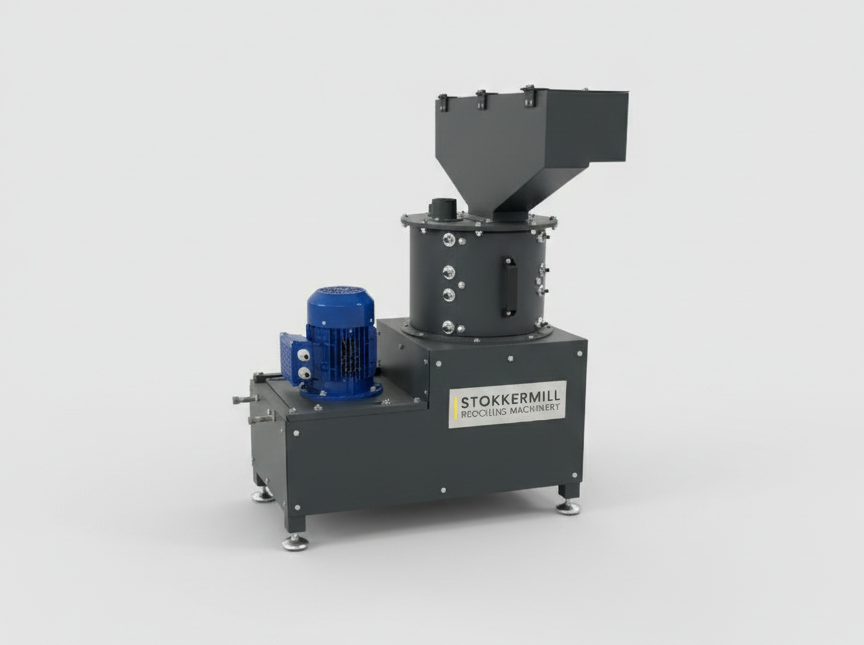
LC-100 Chain Mill for Size Reduction in Recycling and Materials Recovery
The LC-100 Chain Mill is engineered for high-energy impact size reduction, a technology widely used in recycling labs, materials recovery facilities (MRFs), and R&D environments for sample preparation and material characterization.
The crushing system consists of alloy steel chains mounted on a high-speed rotor. During operation, the chains strike the material against a reinforced stator liner, delivering intense impact forces.
Compared to conventional blade mills, chain milling technology provides several advantages for recycling and secondary raw materials processing:
- Ability to handle soft, brittle, fibrous, glassy, or partially elastic recycled materials
- High tolerance to variable moisture content and occasional hard contaminants
- No cutting edges, reducing wear-related performance loss
- Dynamic crushing action that minimizes bridging, clogging, and material entanglement
- Low-maintenance design, with fast replacement of chains and screens
Operating Principle
- Material is fed through a hopper equipped with anti-backflow protection
- The rotor (up to 350–550 rpm) generates a high-energy impact field via rotating chains
- The material undergoes repeated impacts, progressively reducing particle size
- Processed material is collected in a dedicated external container (not included)
Applications in Recycling and Materials Processing
Sample preparation for:
- Chemical and physical analysis
- XRF, XRD, and spectrometric testing
- Thermal analysis and reactivity studies
- Blending trials and pre-treatment of recycled feedstocks
-
Typical Materials and Recycling Streams
- Spent catalysts, technical ceramics, refractory waste
- Minerals, aggregates, fillers, fertilizers
- Rigid polymers, brittle plastics, and regrind materials
- Glass waste, light bulbs, LCD panels
- Dry agricultural by-products (seeds, animal feed, dried fibers)
Data Acquisition and Process Monitoring System (Optional)
The LC-100 can be equipped with an advanced data monitoring and logging module, ideal for R&D labs, quality control, and process optimization in recycling operations.
Monitored Parameters:
- Real-time power consumption (W / kW)
- Energy consumption per cycle or per unit mass (Wh/lb or Wh/kg)
- Rotor torque / resistance, used as a proxy for material hardness or grindability
- Rotor speed (rpm)
- Grinding chamber temperature
- Vibration monitoring (chain integrity and wear detection)
System Capabilities:
- Continuous data logging with CSV export via USB or Ethernet
- Automatic power–time and specific energy graphs
- Ability to correlate crushing energy with:
- Final particle size distribution
- Mechanical strength of recycled materials
- Presence of hard contaminants or inclusions
These features make the LC-100 particularly suitable for advanced recycling R&D, material characterization, comminution studies, and energy-efficiency analysis.
Key Advantages vs. Blade Mills in Recycling Applications
- High versatility across a wide range of recycled materials and hardness levels
- Stable long-term performance with no blade edge degradation
- Reduced risk of jams, even with fibrous or elastic waste streams
- Fast and simple maintenance, with quick chain replacement
- Controlled particle size distribution via interchangeable sizing screens
- Scientific process insight through power, energy, and resistance data logging
Models Comparison
| Specifications |
LC100 |
LC200 |
| Grinding principle |
Impact with rotating chains |
Impact with rotating chains |
| Chain material |
Alloy steel |
Alloy steel |
| Number of chains |
8 (2 pairs) |
8 (2 pairs) |
| Rotor speed |
350/550 rpm (adjustable) |
350/550 rpm (adjustable) |
| Motor power |
0.75 kW |
1.1 kW |
| Power supply |
400 V three-phase |
400 V three-phase |
| Max piece size |
20–15 cm (custom) |
20–15 cm (custom) |
| Throughput |
1–30 kg/h |
1–40 kg/h |
| Grinding chamber |
Steel |
Steel |
| Weight |
100 kg |
150 kg |
| Dimensions |
800 × 900 × 1200 mm |
800 × 750 × 1000 mm |